Tuesday, January 23, 2007

eBook publishing as home business

I’m thinking of publishing my own ebook. It seems ebook authors are thriving on the Net these days.


I’ve been reading a lot on ebook publishing and realized that it is the fastest, easiest and cheapest way to get my writing in print. As a business, it has a lot of promise.

Why an e-publishing business?

Self-publishing ebooks and information products has never been easier than with the many different ebook compiler software programs that are available today. Digital publishing is a good alternative in publishing materials aren’t usually accepted by traditional publishing companies.

In this internet age, ebook publishing has created a whole new era in book publishing. Even paperback authors consider eBooks a new, and different marketing channel for their literary work.

The important part of the ebook phenomenon is that any ebook can be converted easily into an audio ebook, one of the fastest growing segments on the Internet today

In addition, ebook publishing is an exciting new way to make extra income from the Internet. In fact there are many sites that will allow writers to list their ebooks for free. This is a great way for me to distribute my ebook with all of my own url codes embedded within the ebook.

Ebook publishing, however, isn’t replacing traditional publishing anytime soon. It is still nice to curl-up in bed with a paperbound book. But the cost saving potential of ebook publishing is convincing. Moreover, ebook publishing looks like fun and could be an ideal home-based online business for me.

Tuesday, January 16, 2007

Successful 12th ASEAN and 2nd East Asia Summits in Cebu


The Philippines successfully hosted the last ASEAN and East Asia summits in the famous island of Cebu.

Leaders of the Association of Southeast Asian Nations approved a series of declarations on issues ranging from trade to terrorism.

Here are the main points:


* Blueprint approved for ASEAN's first legally binding charter since its founding in 1967. It would turn the 10-nation group into a European Union-style legal entity with binding rules and regulations, and end the tradition of consensus decision-making in all cases.

* Declaration approved on protecting millions of migrant workers from "grave risks of exploitation and abuse."

* Target date for establishing an ASEAN Economic Community, creating a single market of 570 million people, to be brought forward five years to 2015.

* Anti-terror convention signed to make it easier to track and extradite suspects. "Root causes" of terror should be addressed.

* Major powers urged to break the deadlock in global trade talks and move towards an early conclusion of the Doha round, to spur economic growth and alleviate poverty.

* ASEAN leaders urged international lenders to consider swapping debt for equity in projects to enable poor countries to reduce poverty.

Leaders of East Asia reaffirmed their commitment to the eradication of poverty in the region during the 2nd East Asia Summit (EAS) held at the Cebu International Convention Center (CICC).

The East Asian leaders also agreed to increase cooperation in securing energy supply in the region as an important pillar of their common effort to further promote the region’s economic growth, one of the fastest in the world.

All the agreements made during the summits were people-centered. It may as well be because countries participating represent around three-fourths of world population.

Some news sources say that the recent summits were the most productive in the history of the ASEAN. It should be because the summits lasted from December 2006 to January 2007 (just kidding!)

A large part of the success of the two summits may be attributed to the cooperation of Cebuanos and volunteers from other provinces, as well as the generally peaceful rallies. As noticed by many people, most members of militant groups who came to Cebu for the rallies were from Metro Manila. The police said that local protesters behaved better unlike their counterparts from Luzon who came here to join in mass demonstrations.

I’ve heard reports that some of these protesters were armed with steel bars wrapped in newspapers during one of the rallies. The intention of protesters from Manila was obviously not to have a peaceful protest in this island but to provoke the police here so there would be a scuffle to call attention to themselves.

Good thing that the presence of the Cebu City mayor during the rallies prevented any violent dispersal. The mayor also noticed that those who led the rallies were not from Cebu and that they did not have the support of Cebuanos.

After seeing how these groups carried themselves, more and more Cebuanos have a negative view of militants and leftists. Cebuanos would rather mind their business and work to feed their family. I'm glad to know that our locals have enough good sense to stay away from trouble.

Monday, January 08, 2007

Assets and Liabilities

”The reason why most Filipinos are languishing in poverty is because they are financially illiterate and they think with their emotions.”

That was the comment made by a foreigner friend who used to work as a stock broker. He found it shocking that some local professionals (doctors, dentists, lawyers, etc.) can’t even distinguish between assets and liabilities. Moreover, he couldn’t comprehend how these people managed to live on just one source of income considering that they are supporting not just their own families but also their siblings’ families.

According to this foreigner, assets are anything that brings money in the pocket. Liabilities are anything that takes away money from the pocket. It’s as simple as that.

Here is the interesting part ---- his own examples of liabilities: house, cars, clothes, jobless husband / wife, high spending girlfriends/ boyfriends, dependent relatives, children, credit cards.

His examples of assets are bank notes, treasury bills, dividends, royalties, bonds, intellectual property, land/ real estate

The problem with most Filipinos, he observed, is that they delude themselves into believing that a house, cars or children are assets. “Just because these things make you happy doesn’t mean they are assets. Once people accept this fact, they’ll realize the need for more than one income to support their liabilities and keep ahead of expenses.” He immediately clarified that people need not get rid of all their liabilities because that would be impossible. How about adding income sources and decreasing expenses, he suggested.

How can they get other income sources when they hardly have enough time for themselves, I asked.

He chuckled and said that income doesn’t always come from regular jobs, those that pay you for your time. “Haven’t you heard of passive income or portfolio income? Examples of passive income are rental payments, royalties from creative or information products, patents, dividends from shares holding and limited partnership in enterprise. Portfolio income include proceeds from stocks, bonds, equities and t-bills. These are revenue streams that do not require your direct personal involvement in order to keep coming in.”

He glanced at me and paused to make sure everything he said sunk in (This cold blooded bloke sure knows what he is talking about!).

"Do you want to be able to take time off whenever you want to, without worrying about what's going to happen to your current job or business, earn more and work less?”

Good. So do I, he added, that is why financial literacy is important.

“Poverty will not be solved with more money if the mindset of poor people has not changed. Just listen to those street protesters who expect government to feed them and provide them shelter”, he intoned. “Those poor people will forever be dependent on someone for their needs, living a pathetic hand-to-mouth existence. Even if you give them a lot of cash, they'll spend it all because that is how they were programmed to handle money. To them, nothing is ever enough. And look at those office workers who constantly rely on loans to cover their huge expenses and to fill the urge to buy things they don’t really need.”

” They are trapped by their own ignorance and unbridled emotions”, he said with a smirk.

”Instead of wasting time gossiping about their neighbors or blaming the government, Filipinos should be talking to stock brokers, financial analysts, tax specialists, bankers or anyone in the know about wealth building. If not, they can make productive use of their time teaching their children to be self-reliant.”

There is really a need for parents to show children how to create and handle money, my foreigner friend underscored, because financial education is usually obtained in everyday experiences not in schools... especially not in Philippine schools.

What can I say, he was right. Truth hurts though.

Friday, January 05, 2007

Sinulog Bazaar

Next week, my office will be assisting the Sinulog Bazaar at SM Cebu City Mall and the ASEAN trade fair at the Cebu International Convention Center.

The bazaar & trade fair will run until the third week of January to give savvy shoppers enough time to rummage through the shelves and discover finds.

Because of the Sinulog bazaar’s wide array of offering, the activity consistently draws market from all sectors and ages. In fact, it not only attracts retailers in search for something different, it has likewise been a favorite destination for small and medium entrepreneurs looking for suppliers.

This year, majority of the exhibitors are manufacturers of local-made products who have the capacity to supply wholesalers.


It seems that Cebu continues to be an ideal site for trade fairs and bazaars, particularly during the Sinulog Celebration.

This has been proven by the number of trade fair and trade events last year. Many of the trade fair participants in past Sinulog years were able to generate large sales.

The Sinulog side events, described by business moguls as a marketing phenomenon, attracts a staggering number of vendors and buyers (local and foreign). Huge, jaw-dropping number of small vendors swarming all over our streets is a common sight before and during the grand mardi gras.

The Sinulog trade fairs/ bazaars have also provided exhibitors the opportunity to test the local market for their products and to establish linkages with prospective clients and distributors. Retailers, on the other hand, have found suppliers and new products in these trade events.

Wednesday, January 03, 2007

Terminal Report on the Visayas OTOP Trade Fair 2006


I'm usually saddled with preparing the terminal reports of almost all major activities organized by my office. Here is one of those reports. I'm posting it because it comes in handy when I want to refer to it in the future. It will also give you an idea of the results of our efforts. Note that my office was only given a very short time to do the publicity for the activity -- so don't be shocked by the low sales figures.

FINDINGS

The trade fair was able to accomplish its major objectives, namely: marketing the OTOPs of municipalities in the Visayas, building awareness among the general public on the OTOPs of municipalities and encouraging LGUs to actively participate in the OTOP program.

Focus on the One Town, One Product (OTOP) program as a development and branding strategy was reinforced. In fact, products of municipalities in the three Visayas regions were given the spotlight during the trade activity.

With one-hundred-seventy exhibitors from regions 6, 7 and 8, the recently concluded Visayas OTOP Fair held in Cebu generated interest from buyers, garnering total sales of P4, 097,824.18 in cash and booked orders.

Trade exhibitors generated cash sales of P 1,329,480.18 with booked orders of
P 1,401,994.00. Total orders under negotiations reached P 1,401,994.00.

Top selling region was Central Visayas which raked-in total sales of
P 2,691,337.90.

Bannering the theme “A Feast for the Senses”, this year’s Visayas OTOP fair brought together exquisite products such as hand-woven fabrics of raffia, pina and sinamay, fashion accessories, footwear, a generous array of exotic items, home furnishings, decors and processed food.

Apart from the 66 Central Visayas micro and small enterprises displaying their crafts, the showcase also featured 28 exhibitors from Eastern Visayas and 76 from Western Visayas.

A total of 314 guests attended the trade fair including Keynote Speaker Secretary Mike Defensor, Guest Speaker and DTI Secretary Peter Favila, OTOP Program Manager and DTI Undersecretary Carissa Evangelista, SMEDSEP-GTZ Program Manager Martina Valhaus and PCCI President Donald Dee.


There were two side events during the trade fair: Go Negosyo Forum and Food Safety and Packaging Solutions Seminar. The Go Negosyo
Forum featured Julie Gandionco of Julie's Bakeshop, Jay Aldeguer of Island Souvenirs, Justine Uy of Profoods, and other successful OTOP entrepreneurs from Cebu. The Food Safety and Packaging Solutions Seminar featured experts who provided an overview on food safety and one-on-one consultations for the small and medium entrepreneurs. The packaging seminar also offered food manufacturers with innovative product design ideas.


Below is a copy of the trade fair opening program and a synopsis on the speech of secretary Mike Defensor and DTI secretary Peter Favila.


OTOP Visayas Trade Fair

November 23, 2006

10:00 to 11:05 AM

SM Trade Halls, Cebu City

10:00am

Doxology and Invocation

10:05

National Anthem

10:10

Opening Remarks by

Undersecretary Carissa Cruz-Evangelista

DTI ROG Usec/National OTOP Program Manager

10:20

MESSAGE

Secretary Peter B. Favila

DTI

10:30

Introduction of Guest of Honor

10:35

SPEECH
Secretary Mike Defensor

11:00

Ceremonial opening


Ribbon Cutting

Sec. Mike Defensor to be assisted by Sec. Peter Favila, Usec Carissa Evangelista, Amb. Dee Donald (PCCI), Mr. Francis Chua (FFCCI), Mr.Sergio Luis Ortiz (Philexport) and other VIPs

Secretary Mike Defensor

To signal the opening of the trade Fair by blowing a whistle to start the Mardi Gras

Secretary Peter B. Favila will make the intro drumming. LGUs / VIPs will blow whistles while Ati-atihan dancing is going on

11:05

Photo opportunity with Sec. Mike Defensor

Speech of Secretary Mike Defensor (Summary)
Opening Ceremonies: 1st OTOP Visayas Island Trade Fair
SM Trade Halls, Cebu City, 10:00 A.M., 23 November 2006

More than a thousand jobs and millions of pesos worth of product sales have already been generated through the "One Town, One Product" (OTOP) project since its inception in the country two years ago.

The OTOP, a project implemented by the Philippine government was able to engender employment opportunities and propel several locally produced products to marketing success.

If the LGUs, DTI & other cooperating agencies maintain these gains of the OTOP, better opportunities would undeniably be brought to the provinces and rural areas in the coming months.

Our government has always supported micro, small and medium enterprises (MSMEs) through the OTOP project. In fact, the OTOP is one of the priority projects of the Arroyo administration to alleviate poverty by encouraging entrepreneurship and creating more jobs. OTOP-Philippines assists MSMEs to manufacture, offer and market distinctive products or services through the use of indigenous raw materials and local skills and talents. The program also offers a comprehensive assistance package through a convergence of services from local government agencies (NGAs) and the private sector. This includes business counseling, skills and entrepreneurial training, product design and development, appropriate technologies and marketing.

With the OTOP project, the government is setting the trend for the preparation of processors to meet international standards for a more challenging and better vista in their entrepreneurial careers.

Judging from the diversity of products in this trade fair, it is clear that a wealth of opportunities awaits our entrepreneurs in the Visayas. The choices are becoming more varied since each municipality in each province has its own unique OTOP.

I understand that products and services prioritized by our town mayors have competitive advantage over other products and services of other provinces and cities. Boracay Island, for example is a major tourist destination of the country and brings in the bulk of local and foreign tourists to Panay Island, while Cebu’s furniture has already captured the foreign market and won awards for many Cebu furniture makers.

At this point, allow me to
thank and commend the LGUs of the Visayas as well as other cooperating agencies for your very active participation and support in identifying and developing OTOPs for your respective areas.

A shining illustration of a face of OTOP and of a successful convergence or inter-agency cooperation in the selection of an OTOP is the case of the Biliran Integrated Coconut Industry, Inc. This enterprise utilizes the waste products of copra production -- coco husks and shells – to produce coco fiber and coco dust. Coco fibers are made into liner sheets to produce houseware and décor items while coco dust is mixed with decay-enhancing substance and agro-waste to produce natural fertilizer. Coco shells are also cut into shapes and used as accents for handcrafted décor items. Because of abundant and reliable raw material supply and high local and global market potential for these products, the Municipal Mayor of Naval, Biliran – with the concurrence of the OTOP Task Force members -- composed of the DTI, DOST, TESDA, Philippine Coconut Authority (PCA), and Fiber Industry Development Authority (FIDA) – selected in April 2005 coco by-products processing as the OTOP of the Municipality of Naval. And this was eventually chosen as the model Provincial OTOP of Biliran. The OTOP Task Force interventions came in terms of linkage with equipment and materials supplier, business counseling, skills and entrepreneurial training, productivity training, technology assistance, product design and development, local study missions, and marketing assistance and facilitation thru local national trade fairs.

Today, the enterprise plans to expand into the export markets of Europe and China, up production by getting additional equipment, set up raw material buyer centers in all municipalities of Biliran, add another product line such as VCO, vinegar, coco charcoal and other coco-based food products, and set up production units in other municipalities.

What a remarkable and inspiring experience, don’t you think so? And this success story can be replicated many times over in many more municipalities in the Visayas to produce more success stories thru the convergence and intervention of OTOP mechanisms.

Indeed, the development of OTOPs represents an opportunity for dynamic collaboration among local LGUs, NGOs/private sector groups, the DTI and other government agencies to promote wide-based grass-roots entrepreneurship as well as the generation of investments, incomes, livelihood opportunities and direct and indirect employment.

Although the idea started in Japan, Filipinos, through their active and passionate participation, have successfully adopted the OTOP concept and made it their own.

But that should not keep us complacent. Let us continue to empower and position our people as world-class entrepreneurs, capable of competing with their international counterparts, and ready to avail of the opportunities for growth.


The Arroyo administration
remains firmly committed to support the LGUs and business community of the Visayas in fortifying your region’s competitive edge and creating sustained stability and prosperity for its citizenry.

In closing, let me emphasize that much good can be expected from a united people with passion to achieve a common goal. And with our business friendly environment, we will continue to create jobs, livelihood opportunities, and incomes, and improve the quality of life of our people, particularly those in the countryside.


Message of DTI Secretary Peter B. Favila (Summary)
Opening Ceremonies: 1st OTOP Visayas Island Trade Fair
SM Trade Halls, Cebu City, 10:00 A.M., 23 November 2006

Top-billed by Boracay, Cebu, Bohol (and Palawan), Central Philippines - as the President has recognized, attracts more than half of the foreign tourists that come in to the country. And thus, as the President said, the priority for your super region is tourism investments.

Of course, with your high tourism investment potential come the products you offer – since the other side of investments is trade. The Visayas has the good fortune of being blessed not only with magnificent natural wonders but also with abundant resources and highly skilled, creative and talented craftsmen. These factors represent a wellspring of opportunities for developing SMEs that harness the strength of each province or municipality.

The DTI has been working in partnership with your region’s local officials in identifying your regions’ priority products under the President’s One Town, One Product (OTOP) program which seeks to develop more countryside products and business activities through micro, small and medium enterprises.

From a national standpoint, the 16 regional model OTOP products in 2004 have now spawned 83 validated provincial OTOP products which in turn have: developed 3,000 new MSMEs, generated 102,423 new jobs, exported US$113.98 million, and sold P2.19 billion worth of OTOP products in the domestic market. Likewise, 130 OTOP Pasalubong Centers have been established in airports, bus terminals, sea ports, train stations, and there are currently 1,129 market outlets all over the county where OTOP products can be found.

Let me underscore that essential to the success of OTOP is the institutional support of its stakeholders. Up until the August, 459 Memoranda of Agreement have been signed with partners from the cities and regions. Recently, we have signed MOAs with the following institutions whose functions are critical to the development of OTOP:

  • League of Municipalities of the Philippines to include OTOP in every town’s Municipal Development Plan, advocate OTOP in their municipalities, and make available its facilities to assist in the development of OTOP entrepreneurs;
  • National Livelihood Support Fund (NLSF) to provide a special financing window for our OTOP MSMEs and other capability-building interventions through its resource development network;
  • Philippine Information Authority (PIA) to assist in the creation of the OTOP Communications Plan and to actively participate in the promotion of OTOP products and MSMEs in the tri-media;
  • Air Transportation Office (ATO) to make available its facilities for OTOP special settings and OTOP product counters;
  • Technical Education and Skills Development Authority (TESDA) to provide training for OTOP MSMEs.
  • We expect more support from different organizations to partner with us in the development of OTOP. For example, later in this program, we shall witness the signing of MOAS between the DTI and the following:
  • Union of Local Authorities of the Philippines (ULAP)
  • Philippine Chamber of Commerce and Industry (PCCI)
  • Philippine Exporters Confederation (PHILEXPORT)
  • League of Cities of the Philippines
  • Philippine Center of Entrepreneurship (PCE)

To these institutions, let me say thank you very much for your willingness to support and serve as our partners in developing, implementing, and promoting the OTOP program.

I am also proud to remind you that in addition to the grand opening of this OTOP Visayas Trade Fair, we will also be launching this afternoon the Cebu City National Economic Research and Business Assistance Center. This Center will assist prospective entrepreneurs and investors in the country towards enhancing the process of business formation and entrepreneurship. The center will also facilitate the processing and documentation of all requirements in the establishment of a business in the country and link prospective entrepreneurs to credit services.

Likewise, we will open the DTI Business Technology Center, in partnership with Intel Microelectronics Philippines and Globe Telecom, in recognition of the importance of ICT in the development of one’s business. The BizTech Center serves as a one-stop IT help-desk to help MSMEs understand the benefits of technology in their business, providing access to technology tools, experiential marketing and training to allow them to operate more effectively and be more competitive using technology. It will offer training from SME counselors with modules done in coordination with Intel and with the University of the Philippines Institute of Small Scale Industries (UP ISSI) and provide computer training through the PCs in the center.

So there – a lot of good things in the offing for the Visayas SMEs.

In closing, allow me to encourage our entrepreneurs here to continue availing of DTI’s many programs for SMEs. DTI would be happy to assist SMEs in their continuing process of evolution – from the development of their products and designs, to their upgrading and modernization to suit current market trends, to acquisition of vital technology for production, to obtaining various types of financial assistance and credit thru our SULONG program and its various innovations, to market testing and promotion thru trade fairs and buyer-supplier matching activities.


RECOMMENDATIONS

It is recommended that the agency’s trade fairs be timed with the holding of fiestas in provinces such as the Sinulog of Cebu and the Sandugo of Bohol or any large, high profile events to maximize visitor traffic.


It is also recommended that trade fairs be held in shopping malls since these venues are natural attractions to buyers.


FUTURE PLANS

DTI-Central Visayas Office, together with the Regional Operations Group, plans to re-discuss relevance of trade fairs, rethink present strategies to promote local products and explore new marketing channels.


EXHIBITORS

Please see attached sheet.


BUDGET

The activity incurred a total cost of P___________.

Friday, December 29, 2006

Physical Exercise and Brain Efficiency

You may have noticed that I haven’t been updating my blog as often as I should.

I’ve entered a mall-based fitness club two months ago.

No, it’s not for weight reduction, although I certainly need to lose a few pounds. I just want to engage in regular vigorous activity to prevent stress and boredom. And considering that the club is based inside a mall and closes at 10:00 in the evening, it made exercise very attractive to me. I also read somewhere that people with blood type O (me included) need to undulge in intense physical workout to feel good and be healthy.

There was a study of over 2,000 French adults which indicated that ones weight can directly effect mental functioning. Researchers found that participants with a higher Body Mass Index (BMI) did not perform as well on a battery of standard cognitive tests, assessing abilities like memory, attention and speed of learning, attention and speed of learning. The results indicated that not only did individuals with higher BMIs perform poorer, but they were also at greater risk for dementia later in life.

Exercise is an excellent antidepressant I was told and, according to experts, a great anxiety prevention..

For an investment of at least 20 minutes, 3 times a week of physical exercise, you get: a detox treatment, improved thinking, and decreased stress, anxiety, depression, and addictive tendencies --- certainly a good deal! Not to mention weight loss, increased energy, and socialization (that is why I joined this horrendously expensive “exercise club” …ha…ha…ha).

An interesting component to the stress reduction is not just the physical burning up and removal of stress hormones, but also the sense of control that a regular workout gives you. The sense of autonomy you get by taking control of your health is a great stress reliever.”

I recently learned that if you play sports that involve strategy and skills, it will give you a brain workout. I use the time in the gym to focus on my breathing and/or technique so that I get a meditative workout.

So, with a good workout, you can accomplish 3 of the 4 brain fitness pillars at one time: physical exercise, mental stimulation and stress management. Add in a balanced diet and you're ready for the travails of life!

Monday, December 04, 2006

ASEAN Summit Fever


The Philippines is ready to host the 12th Summit of the Association of Southeast Asian Nations (ASEAN) in Cebu City on Dec. 10-14.

The summit is supposedly an important benchmark to accelerate free trade within the ASEAN region from 2010 to 2015.

Ten ASEAN leaders from Brunei Darussalam, Cambodia, Indonesia, Laos, Malaysia, Myanmar, the Philippines, Singapore, Thailand and Vietnam will converge in Cebu City to discuss a wide range of issues such as trade, investments, security, including the all-out war against international terrorism, among others.


My agency is certainly ready with the tokens (which come from the provinces of Cebu, Negros Oriental and Bohol) for the ministers, their spouses and other foreign dignitaries.

Here are photos of some of our gifts ...


Friday, October 20, 2006

Building personal wealth

By just looking around, you can understand why the lack of wealth cripples a person’s ability to enjoy life. (An indigent person will always be thinking of his day to day survival. This means that comfort and pleasure is treated as a rare luxury. )

Is building wealth really as difficult as most Filipinos say?

Well, that depends on their definition of wealth.

I don't care much for luxury cars, huge houses or flashy entertainment components. As far as I know, I just want to live life on my terms, and that doesn't take much.

Most Filipinos probably feel the same way I do, the problem is that they don't know how to achieve it.

Financial advisers say that wealth creation isn't really all that complicated. In fact, they believe there are just four vital steps for an ordinary Filipino individual to achieve personal financial security:

Save first and refrain from buying unnecessary items. This can be difficult for compliant Filipino parents who want to please their demanding kids; but learning to say no can work wonders to the family coffers. (one of my pet peeves is someone who makes a habit of asking money or treats me like an Automatic Teller Machine).

More often than not, financial growth is incremental, with our personal net worth increasing steadily over time. Savings cover a significant role in wealth creation.

Most rich people are quite conservative in what they buy. This habit is what enables them to become wealthy in the first place, but even after they have achieved financial security they tend to appreciate the value of saving (and buying assets), rather than purchasing luxuries.

As research show, many people who buy expensive watches, clothing, cars and homes are, in fact, not yet wealthy. Rather, they want to appear wealthy. By spending money on items that do not produce income (liabilities), wealth remains elusive for most of these individuals.

Take the case of Filipino Overseas Contract Workers. Most consume all of their earnings to buy consumable items for “pasalubongs” to their family and relatives, easily burning a hole in their pockets. They end-up as poor as before they left to work abroad.

Buy assets, not liabilities. Asset means: something that will put money in your pocket over time such as investing in stocks. Liability means: something that will cost you money over time such as buying a luxury car which depreciates and expensive clothes (and even “ukay ukays” if done to the extreme) which become rags in a year.

Be very careful with handling loans. An official of a credit information provider once said that for Cebu to become the “next big thing in Asia,” Cebuanos need to change their views on handling debts. This means that Cebuanos must learn discipline in their use of loans and must pay their basic obligation.

“Non-payment of loans when these are due causes an increase in the cost of borrowing, thus resulting in a slowdown of the economy and the inability of most companies to expand their business.”

Continue to learn how to earn money and find new ways of managing it. Enroll yourself and your kids to schools that teach investment or overall financial know-how.

I believe that kids as young as five years old should be exposed to knowledge on wealth creation and management, especially here in Cebu, a hub of trade in the Visayas-Mindanao area, where everyone is expected to be entrepreneurial. “Today's global economy demands a constant upgrading of skills, and a general overall knowledge of investing.”

Financial security is within everyone's reach; it just takes knowledge and discipline.

Friday, October 13, 2006

Handbook on Consumer Assistance and Protection

I'm currently writing my initial inputs for the Handbook on Consumer Assistance and Protection which will be used by members of the Barangay Consumer Advocacy Assistance and Protection Team (C.A.P.T.)

I. Sample cases of scams

A year ago, unscrupulous persons posted themselves as representatives of "Masumi Corporation and Sakaki Takiyama" with supposed address at No. 188 Sergio Osmena Street, Cebu City.

Despite the various advisories issued by the DTI, there were still consumers who were fooled by these swindlers. These swindlers promised bigger cash prizes and claimed that they were provided by SMART and GLOBE with cellphone numbers of their subscribers.

These cellphone callers then informed their victims that their cellphone number won during a raffle activity conducted under the supervision of a DTI representative.

To win the confidence of their would be victims, the caller will give them the following information to make the sales promo seem legitimate:- company name which is foreign sounding;- a sales promo permit number;- a company's representative of which they can only be contacted through their cellphones;- postal address.

Another ploy used by unscrupulous persons is to call the victim and tell the victim that his mobile number won as a homepartner winner in the Lotus Ballpen Philippines' "Magkapera't Magkakotse Raffle Promo" and that he won a Toyota Corolla Altis and P20,000.00.

These callers then identify themselves using fictitious names. One caller even mentioned a DTI-NCR permit number 772813-5 to make the promo appear credible.

The victims are then asked to give the callers the numbers of their two (2) prepaid cards worth P300.00 and for the victims to shoulder the storage cost of the Toyota Altis at P16,000.00 per day by depositing the amount at a certain account in a specified bank.

Another sales promo scam used by swindlers is tell the victims that their names, which appear in the PLDT directory, were chosen as winners of a raffle draw.

The callers will then cite the name of the Philippine Racing Commission, PAGCOR and even well known companies as promo sponsors to appear credible.

These callers ask their victims to deposit as much as P20,000 by 12:00 noon on that day to a certain account so as not to forfeit their prize. These callers will say that this amount is needed to defray cost involved in the transport of the vehicles won.

If their victims are not convinced the first time, these callers will again call and persuade the victims to change their minds.

Still another favorite ploy of swindlers is to call people and tell them their mobile phone numbers were picked as the winning numbers in a sales promotion allegedly approved by DTI or DOH-BFAD.

Other swindlers inform the consumer through text messages. Among the schemes employed to deceive the public is persuading the unsuspecting consumer to purchase eight cell cards from a certain cellphone company and tell him to text the pin numbers of these cell cards in order for him to avail of the first prize amounting to P 2 million. These swindlers sometimes drop names of prominent individuals just to convince the victim to join.

Another bogus scheme is for swindlers to use an existing sales promo such as the well known GAME K-N-B. They will tell the victim that he has just won in the home partner raffle draw last July 26, 2002 amounting to P3 million pesos.

The most alarming modus operandi employed by another swindler is introducing himself as an employee of DTI, to trick the victim into joining. Afterwhich, the swindler tells the victim that he has won P750,000 to P1 million in a PAGCOR promotion.

In all these promo scams, the name of a contact is given and his cellphone number. The person contacted will then give the victim instructions such as depositing a substantial amount in a certain bank account or giving the pin numbers of cellcards in exchange for of the prizes.

The DTI7 has observed that the swindlers posing as sponsors of fake promos are now offering cash prizes instead of the expensive cars which they used to offer.

II. Definition of the Problem

Q. When is a sales act considered deceptive?

A. A sales act or practice is considered deceptive whenever the producer, manufacturer, supplier or seller, owner or operator of a consumer service or repair shop induces a consumer to enter into a sales or lease transaction of any consumer product or service through concealment, false representation or fraudulent manipulation.


Q. What is unfair or unconscionable sales act?

A. An act of the producer, manufacturer, seller or supplier of a consumer product, or the owner or operator of a consumer service or repair firm of inducing, or enticing a consumer to enter into a sales or lease transaction of a consumer product or to avail of its services grossly inimical to his interests or grossly one-sided in favor of the producer, manufacturer, distributor, supplier or seller, owner or operator, by taking advantage of the consumer’s physical or mental infirmity, ignorance, illiteracy, lack of time or the general conditions of the environment or surroundings.

Q. Why is the “No Return, No Exchange” notice considered deceptive?

A. The “No Return, No Exchange” notice is considered deceptive because it creates a misconception on the part of the consumers that they do not have the right to return shoddy or defective goods or demand for remedies in case of defective or imperfect service.

On the contrary, consumers may return or exchange goods or avail of other remedies in case of hidden faults or defects, or any charge not known to buyer. By provision of law, sellers are obliged to honor their implied warranties and grant corresponding remedies.to consumers.

Q: What is a home solicitation sale?

A: Home solicitation sale means consumer sales or leases which are personally solicited by any person, organization through person-to-person contact at the buyer’s residence, place of work, at the seller’s transient quarters, or any appointed place, except the seller or lessor’s usual place of business.

IV. Common practice or modus operadi

DTI-7 regional director Asteria Caberte points out some of the present modus operandi of unscrupulous traders that consumers should be wary of:

Instant Raffle Draw Contest
"Don't be deceived if somebody approaches you either in the mall or in any business establishment telling you of a free raffle", Caberte warns. "Usually the pseudo-raffle draw is the scratch and win type.

If you take their bait, you will soon find out that you will be made to shell out a substantial amount of money for high end products as a pre-condition for the release of a promised prize."

Caberte describes how three or four sales people will gather around customers to overwhelm and subtly pressure them to buy. "They even go to the extent of filling out the forms for customers, so these customers will give cash or use their credit card", she said.

Raffle Draws Through Text Messages and Cellphone Calls
If you receive a call or a text message congratulating you for winning either one million pesos or a brand new luxurious car, think again. You might fall prey to this trap, Caberte relates, "after telling you of the supposed "good news", they will tell you to deposit an amount to a certain bank account before 12:00 noon on that same day, otherwise, another winner will be drawn since you have not met the deadline."

Before, it used to be only P6,000. Now it has reached P18,000 or even P20,000, Caberte added. "A day after depositing the amount you cannot reach the person who called you over the cellphone and worse, the account where you deposited your money has already closed.

Door to Door Selling
Unscrupulous sales representatives conduct a door to door selling activity telling an unscrupulous housewife that the wares they are selling are very much lower and better than those in the market.

Caberte says that buying such products from them is unwise. "If it turns out that these products are defective, consumers have no way of returning their products, especially if they forget to ask the sales representatives' business name, their business address or even their identities."

Caberte reiterates to the public to check the validity of all sales promotions they intend to join. "Check if sales promo is indeed genuine before parting with your hard earned money", she says. "Try to get as much information about it such as sales promo permit number, the name of the sponsor, the coverage and most of all the mechanics of the promo. Only then can you detect if it's a scam or a legitimate sales promotion.

If it is a door to door selling activity, ask the sales representative for a home solicitation sale permit. Just like the sales promotions in business establishments, DTI also regulates door to door selling through home solicitation sale permit, Caberte says.

Should consumer fall prey to these unscrupulous sellers, they are advised to file a fomal written complaint with any of the provincial offices of the DTI. Consumer Arbitration Officers will attend to all consumer complaints.

V. Role of the Agency
Monitoring, preventing and enforcing the laws on sales, home solicitation and warranties are handled by the Trade and Industry Regulatory Division of the Department of trade and Industry.(TIRD).

The TIRD performs a number of functions to ensure that consumer's welfare is promoted and their rights protected.

It also provides services to businessmen to help them sustain the viability of their ventures. Its specific concerns in these areas include:
· registration of business name
· issuance of licenses/permits
· accreditation of service and repair enterprises
· processing of patents and trademarks
· technical assistance/consultancy on product standards and other quality-related technical information
· legal assistance
· consumer information and protection
· resolution of consumer complaints and grievances
· enforcement of fair trade laws
· price and supply monitoring and etc.

The National Consumer affairs Council (NCAC) is the body created by the Consumer Act to improve the management, coordination, and effectiveness of consumer programs and policies of the different government agencies and private organizations.

The council is composed of representatives from the following government and non-government agencies:- Department of Trade and Industry- Department of Education- Department of Health- Department of Agriculture- Consumer Organizations of nationwide base- Business/Industry sector


VI. Quick Tips
In order not to be victims of promo scams, the DTI offers all consumers some tips to determine a fake or genuine sales promotion:

1. Consumers who won in a sales promotion amounting to P500.00 or more are always notified in writing by the sponsor with the instruction of what documents to bring in claiming their prizes. Notices through text messages or through phone calls are not enough.

2. Consumers are advised to ask for the sales promo permit number as well as the DTI office or DOH-BFAD office which approved the promo. Better still inquire the name of the DTI or BFAD representative who supervised the draw.

3. Check the promo period as well as the areas covered by the promotion.

4. Always ask the name of the contact person of the sponsor, his address and his landline. All sponsors provide their landline number when applying for a promo.

5. Try to know the mechanics of the promo and how you won.
Under the Consumer Act, a winner of a prize amounting to P500.00 or more shall be notified in writing or by registered mail of by any other form of communication wherein proof of notice or service can be verified.

So if somebody calls you through the cellphone, ask why you were not provided a written notice. Verify also from the DTI-Regional Office or the DTI Provincial offices if they have approved of such a promo.

Sales promotions for food, beverages, drinks, medicines and cigarettes are approved by the Bureau of Food and Drugs – Department of Health. You may also inquire from their office.


Don’t easily part with your hard-earned money. Always check if the sales promo is genuine or not. Try to get as much information about it, the sales promo permit number, the name of the sponsor, the coverage and most of all the mechanics of the promo.

Only then can you detect if it’s a scam or a legitimate sales promotion. Remember " that a well informed and vigilant consumer is the best-protected consumer."

VII. Filing a Complaint

Q. What can a consumer do if he has a complaint?

A. Identify the problem. Identify the problem and what you believe would be a fair settlement. Do you want your money back (Refund)? Would you like the product repaired (Repair)? Will exchange do (Replace)?

Gather documents. Gather documents regarding your complaint. Sales receipt, repair orders, warranties, cancelled checks, or contract will substantiate the complaint and help the company solve your problem immediately.Go back tow here you made the purchase. Contact the person who sold you the item or performed the service. Calmly and accurately explain the problem and what action you would like taken. If that person is not helpful, ask for the supervisor or the manager and repeat your complaint. Many consumer problems are resolved at this level.

Write a formal letter of complaint. If you are not satisfied with the company’s response, write a formal letter of complaint to the consumer protection agency concerned. State your name and address; the name and address of the establishment you are complaining; and the circumstances regarding the complaint including names, dates, places, etc. Also, enclose supporting documents such as official receipts, deed of sale, and the likes, and be prepared to make an appearance when called, especially during the mediation conference.

Q: What is the prescriptive period for filing consumer complaints?

A: Within two years from the consumer transaction was consummated or the deceptive or unfair and unconscionable act or practice was committed, and in cases of hidden defects, from discovery thereof.

Q: Where can a consumer complaint be filed?

A: The administrative complaint shall be filed in duplicate with the Provincial Office of the Department having jurisdiction over the subject of the complaint. In areas where there are no Provincial Offices, the complaint shall be filed in eth Regional Office.

In cases where the complainant and respondent are situated in different provinces, the complainant has the option to choose the place where to file the complaint.

Q. What are the available remedies available to consumers?

A. For Administrative Proceedings:- Replacement or repair of product or services- Refund of payment made- Restitution or rescission of contarct- Reimbursement to complainant fo amount spent in pursuing the complaint.

For Civil/Criminal Action:
Civil action- Award of damages- Replacement of repair of product or services- Refund of payment made- Restitution or rescission of contract- Reimbursement to complainant of amount spent in pursuing the complaint

Criminal Action- Imprisonment or payment of fine or both, at the discretion of the courtQ. What are the consumer responsibilities:

A. Critical Awareness. The responsibility to be more alert and questioning about the use, price and quality of goods and services.

Action. The responsibility to assert ourselves and act to ensure that we get a fair deal. As long as we remain passive consumers, we will continue to be exploited.

Social concern. The responsibility to be aware of the impact of our consumption on other citizens, especially disadvantaged or powerless groups, whether in eth local, national, or international community.

Solidarity. The responsibility to organize together as consumers to develop the strength and influence to promote and protect our interest.

Environmental Awareness. The responsibility to understand the environmental consequences of our consumption. We should recognize our individual and social responsibility to conserve natural resources and protect the earth for future generations.

VIII. Contact details
Consumer Complaints: btrcp@dti.gov.ph
DTI (head Office) Hotline: (02) 751-3330

DTI Central Visayas Offices:

DTI Cebu Provincial Office
Nelia Navarro, Provincial Director
(032) 412-1863
Email: nelia@dticebu.net.ph / dticebu@dticebu.net.ph

DTI-Bohol Provincial Office
Ma. Elena Arbon, Provincial Director
(038) 422-1764
Email: dtibohol@globelines.com.ph / dtibohol@yahoo.com

DTI-Negros Oriental Provincial Office
Javier Fortunato, Jr., Provincial Director
(035) 422-1764
Email: dtinegor@glinesnx.com.ph

DTI-Siquijor Provicnial Office
Nimfa Virtucio, Provincial Director
(035) 480-9065
Email: dtisiquijor@yahoo.com

Wednesday, October 11, 2006

Check Rediscounting Facility

Here's part of a speech I wrote for my boss. This will give you an idea of the new Check Rediscounting Facility of the Cebu-GTH.

How does government assist exporters, particularly those based in Cebu, to face up to the challenge from the domestic and international fronts?

I believe one of the essential steps we need to take is to help their suppliers and subcontractors who contribute 85% of the production process.

The Philippine Export-Import Credit Agency (PhilEXIM) recently provided the Cebu-GTH Foundation Twenty-Five Million Pesos (P25M) to open a Check Rediscounting Facility for the benefit of subcontractors of members, paving the way for easier access to funding in order to purchase raw materials for production.

In Cebu, we all know that exporters rely heavily on subcontractors for their production. It is a sad reality that subcontractors are often confronted by lack of capital which compels them to regularly borrow money from usurers, who charge interest rates between 10-20%.

That is why I am happy to know that the Cebu-GTH Foundation has agreed to provide assistance to its members by way of this Check Rediscounting Facility.

This is a first in the country where an industry foundation tries to professionalize a common practice among subcontractors. Documents such as promissory note, request for availment, job order and post-dated check will have to presented to the creditor in order for a loan to be released.

PhilEXIM, which provided financial assistance to the Cebu-GTH, is a government financial institution attached to the Finance department that is mandated by the government to assure the export sector's speedy and unobstructed access to trade finance.

This is just one way for government to assist exporters who are currently affected by the strong peso.

Government is acknowledging the huge contribution of exporters to the Philippine economy and is doing everything it can to ease their burden.

In any economy, exports provide an opportunity for rapid growth since the other components of National Gross Domestic Product (GDP), such as government spending, consumer spending, and investments may be impacted by other dynamics central to the country itself, and may not grow as fast as the export sector, as has been shown in recent years.

Growth in exports leads to greater employment opportunities and fosters greater productivity which, in turn, allows specialization to occur. In time, as higher rates of economic growth are sustained, a leveling in skewed income distribution takes place.

Exports, in other words, constitute a viable and effective tool against poverty.

Checking on our statistical data, the Philippines’ export landscape has drastically changed in the last 25 years. From being largely agricultural and resource based, exports today consist mainly of manufactured items. Resource-based products have gradually shrunk to a little above 5% of total trade. This means that the export industry is hiring a lot more subcontractors to produce items than they did years ago.

It goes without saying that the DTI will always be supportive to the Philippine export sector.

However, let us bear in mind as we face the global challenge that what happens to us is entirely in our own hands. That is why initiatives such as this Check Rediscounting Facility to ease fund availability for subcontractors is significant.

With this, I would like to encourage those concerned to avail of the new service facility of the Cebu GTH foundation for their liquidity needs.

Let us all support this project.

Monday, October 09, 2006

Visayas fast crafts


Fast ferries in the Visayas will take you to the most popular places of the Visayas in comfort.

It is comparable to flying in quick time. These fast crafts typically have a bar where you can buy snacks and drinks.

To entertain passengers, they show movies or other videos on big television screens.These fast seacrafts are what our office personnel normally take when traveling between islands in Central Visayas.

There are three plying the islands from Cebu: Weesam Express, Supercat and Oceanjet.I took the Weesam in my recent trip to Tagbilaran City for the Sandugo Regional Product Showcase.

Weesam is the newest addition to the fleet of fast crafts in Cebu. The boat looks smaller than the Supercat or the Oceanjet; but the Weesham Express travels faster in my opinion.

What I like about Weesam is that it is always on time (Their engines are probably new). And the ferry’s airconditioner temperature is set just right… comfortable enough for me.

On the other hand, the Supercat temperature seems to be always set too high.

The first and economy class sections in all fast ferries aren’t normally packed with people except during holidays and “fiestas”. So, you can move around to any seat you want. The prices of fast ferries are usually between 350 to 500 Pesos.

There are separate terminals for passengers of fast ferries in Cebu. In Tagbilaran, Dumaguete and Larena, the same terminal is used by all the ferries.

All fast ferries have their own websites for prospective passengers to check out their destinations and schedules. Weesam Express and Supercat have online service which provides a free, easy-to-use, automated reservation system, where anyone can reserve seats.

Most locals usually check schedules of seacrafts in newspapers and buy tickets in travel shops scattered around cities. But I’d rather go directly to the pier to inquire and buy tickets …. nothing beats getting first hand information from the companies.

Thursday, October 05, 2006

Jungle in my front yard

My sister enjoys gardening.

It’s not that she cares for plants; it’s just her way of releasing stress and all the tribulations of work.

Unfortunately, she doesn’t have an eye for aesthetics. She plants whatever catches her fancy. Three months ago it was papaya. The grown plant is presently leaning awkwardly by the balustrade, beside a bunch of ferns. I’m currently sitting under it right now ---- reading a book and sipping hot Chamomile tea.


I also need to relax.

In fact, I’ve voluntarily imposed a “news blackout” for myself today. This means no television, radio or newspapers --- just silence and the company of plants.

A constant supply of "bad news" isn't healthy for our bodies—our cells are designed to take in joy and peace, not catastrophe.

I’ve spent my weekends for the past few months just gazing at these plants, sipping tea, and trying not to think about the office.

There is something about nature that mutes internal chatter and heals the spirit. I also sleep better at night.

Wednesday, October 04, 2006

Strong Peso

The Peso’s strength against the Dollar is increasing.

So, what is the hullabaloo all about?

For those (they are surprisingly in the majority) who have no idea on the significance of the peso exchange rate to the lives of ordinary Filipinos, let me take a leaf from the Bangko Sentral ng Pilpinas.

The appreciation of a currency against other currencies is generally viewed as good as this is a reflection of improved economic fundamentals, that is, lower inflation rate, high balance of payments surplus, etc.

On the other hand, to the extent that the depreciation of the peso against other currencies was due to deteriorating economic or other negative conditions in the Philippines, then a depreciating peso is not good news.

Certain parties, however, may not welcome this increase in the value of the currency. For instance, our exporters and overseas workers get fewer pesos from their foreign exchange earnings every time the peso appreciates.

If the peso’s exchange rate against the US dollar appreciates to P48 from a previous P50 to one dollar, a family which receives $1,000 monthly from their breadwinner-father employed as a computer programmer in New York will get only P48,000. For a ready-to-wear exporter to the USA, the appreciation of the peso by P2 will not be welcome news also. If she sells $100,000 monthly, her total peso sales equivalent will be lower by P2 million.

For foreign exchange earners, an appreciating peso will also be good for a country as a whole if the people prefer imported goods over those locally available, especially if these goods are non-essentials. This is so since less pesos are needed to purchase imported items.

In a situation where the Philippines is getting more connected with the rest of the world, it is more important to see the peso moving along with major currencies, and its trading partners and competitors.

Moreover, it is also significant to consider whether these ups and downs in the peso’s value proceed in a stable manner or at wider fluctuations. Wider fluctuations or greater volatility are disruptive, whether for business planning or for individuals who need other currencies in their transactions. Thus, the Bangko Sentral pays more attention on how the peso moves, causing it to intervene in the market to cushion or smoothen abrupt changes in its value.

As regards to some people who think that government can manipulate a country’s currency value, it may be possible through export subsidies. However, this distorts trade more than any other measure. Undervaluation of a currency through this measure constitutes a prohibited subsidy under international law because the exchange rate does not reflect market conditions.

Export subsidy is the only type of subsidy that the World Trade Organization prohibits outright because this is very damaging to competing economies.

Monday, October 02, 2006

Cebu Island Economic Zone

As reported in the local papers, there is a proposal to turn the whole island of Cebu into an economic zone.

Proponents are currently doing a study to determine the positive and negative effects of the proposal, including reduced cost of doing business, better capabilities, loss of taxes by local government units because the declaration will entail a tax holiday for businesses and industries.

A special economic zone enjoys privileges under the law such as tax holidays and incentives for companies operating within it. The area ideally operates with minimum government interference and allows the employment of foreign nationals.

If this proposal is realized, Cebu will be the first province in the country to become an economic zone. So far, the president, governor of Cebu, some mayors and, of course, all businessmen are amenable to the idea.

I believe this plan will be beneficial to Cebu and can trigger further economic development in the province. Whatever loss the government would have in terms of taxes could be offset by more vigorous development and economic activities in Cebu. The island will become very attractive to investors because of the tax breaks and increased facility in doing business.

The idea to have the entire Cebu Province declared an economic zone will hopefully render the reasons behind the “Sugbuak” moot.

Frankly, I prefer this proposal over that of dividing Cebu island into three provinces (Sugbuak). Dividing the island will not only be counterproductive to business, it will also entail additional expenses for the national government (such as replicating all government agencies in the new provinces, hiring more government employees etc).

Moreover, the availability of additional shares from the Internal Revenue Allotment (IRA) for the towns of the three prospective provinces doesn't guarantee better delivery of basic services --- the same way that having more money doesn't ensure efficiency. Ask anyone who has ever been involved in any humongous project or better yet take a look at the people living in the larger islands surrounding Cebu which have been chopped into smaller provinces. Have their lives improved ?

It is too simplistic to say that the economy of a province will automatically perk up if given a bigger IRA which is the main basis for the bills. Fact is there are several factors to consider in economic development such as infrastructure, accessibility, bureaucratic red tape, peace and order, labor force, sound leadership, corruption, financial management etc.

I hope the residents of Cebu's 4th district, 2nd district and 3rd district have not been waylaid into thinking otherwise. I'll leave it to the Cebu Island Ecozone study group to elucidate further my point since they are better at this.

I’m happy to know that Cebu island ecozone project is nearing realization as the government of Germany, through the German Agency for Technical Cooperation (GTZ), has committed to fund a feasibility study on the proposal until its completion in November this year.

The Cebu Island Economic Zone proposal was conceptualized by the Cebu Chamber of Commerce and Industry. The chamber is also taking the lead in its realization.

The move is consistent with the goal of the business sector of making Cebu an investment hub and dispersing benefits of business development to other parts of the province.

Clavel Asas-Martinez (Cebu, 4th district), Simeon Kintanar (Cebu, 2nd district) and Antonio Yapha (Cebu, 3rd district) were the congressmen who filed separate bills proposing for the creation of three separate provinces out of Cebu Province. The bills are still pending in congress.

Wednesday, September 27, 2006

Central Visayas Export Situationer

The following information was taken from a presentation for the RDC officers meeting this coming Friday which I and my officemate prepared for our boss.

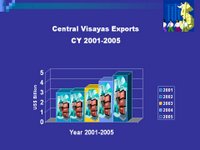
Central Visayas exports (100% of which come from Cebu province) last year registered US$ 4.713 billion, a 13.50% increase over that of year 2004.

As can be seen in the slide, the region’s exports has had a double digit growth since year 2003. It took around five years for local exports to fully recover from the effects of the Thai baht collapse in 1997 which unleashed a wave of currency devaluations across Asia.

If you compare Central Visayas against the Philippines export performance, you can see that the region has fared better. In fact, share of region to total national exports is steadily increasing. Average export growth rate of the Philippines between years 2001-2005 is 6.42 percent; Central Visayas average is 12.1 percent for the same period.


Central Visayas exports last year registered US$ 4.713 billion, a 13.50% increase over that of year 2004.

Exports in the first semester this year is US$ 2.360 billion, a growth of 11.79% compared to the same period in 2005

As usual, electronic products and other industrial goods lead the list of top export performers in 2005.

The other product categories included in the top 10 list are furniture, garments, steel/metal products, electrical equipment, processed foods, marine product, vehicles and gifts, toys and housewares.

Although furniture hasn’t really reached its optimum performance, Cebu based firms had relatively better export sales compared to Metro Manila companies as gleaned from a survey conducted by Pearl 2, a Canadian International Development Agency.

This slide shows the top exporters for year 2005. Most of them are electronics manufacturers.

Central Visayas exports last year registered US$ 4.713 billion, a 13.50% increase over that of year 2004.

Japan remains the top market for Central Visayas in year 2005 followed by United States, Hong Kong, Belgium, China, Indonesia, Korea, Netherlands, Singapore and Thailand.

Sectors that gained in year 2005 were steel/ metal products, chemicals, garments, fresh and frozen food products, processed food and agri/ forest products.

Sectors that declined in the same year were Electronics, Electrical Equipment, Packaging, Furniture, Gifts, Toys and Houseware, Fashion Accessories, Marine Products (except Carageenan), Mineral Products and Traditional Products.

Decrease in electronics in 2005 was attributed to high world oil prices and inflation which weakened consumer spending in US and Japan.

Exports growth of garments could be attributed to bulk orders of brassieres and children’s clothing (NSO).

Here are two of the exporters' concerns which, if addressed, could considerably improve the export performance of the region:

First is the strengthening of the peso. While the Arroyo Administration’s top economic team hail the appreciation of the local currency in recent months, the export industry sector, among others, bewail the dramatic rise of the Philippine peso to its record-high in 3 ½ years citing substantial losses which threaten the industry’s competitiveness.

The Cebu Furniture Industries Foundation said the ideal peso-dollar exchange level for exporters is from 53 to 54 pesos because most exporters do their quotation at this level. Beyond that, exporters will have their export revenues considerably diminished.

Second is loss of our competitive edge in design. Cebu is known as a design destination for the distinct look of its products which uses alternative natural materials for contemporary designs. In an increasingly competitive world, product design is critical. For the past few years, several of good Filipino designers have been pirated or have migrated to other countries. This situation adversely affected the quality and marketability of our products.

However, the Department of Trade and Industry is optimistic that exports in the region will further improve this year. Since 2004, IT and IT enabled services has been included in the region’s export statistics.
The agency expects this sector to surge further this year, as demand increases.

Based on statistical data, exports growth prospects of the region appear to be good. This optimism stems from the anticipated economic growth of the Philippines’ export markets such as Europe and Asia. Surprisingly, China has turned out to be the fastest growing export market of Central Visayas.

Another reason for the buoyant forecast is the increasing attention given to Cebu and its products with the series of high-profile international activities being held here.